


Cross-border house-collecting is gaining traction as a means of diversification for those fleeing political instability and wealth taxes. Indeed, for many of the globally mobile, the concept of primary and secondary residences is becoming outdated, with rotation between several locations across the year now increasingly common.
Luxury real estate is an attractive option due to capital growth potential, lifestyle attractions, and the usual plus-points of good available education and healthcare. A spread of luxury real estate investments hedged across a few jurisdictions remains one of the most stable asset portfolios in uncertain times.
But where to put your money? Whether you’re a pure investor or are in the market for a palm-fringed exit strategy, here are the property hotspots to target in 2026.
Where to buy luxury property
The investment play: Dubai and Abu Dhabi
In May, Fitch Ratings predicted a ‘moderate correction’ in Dubai pricing by 2026, following a 60 percent price increase from 2022 to March 2025. However, oversupply is restricted to the mid-range sector, says Liam Bailey, Knight Frank’s global head of research, with competition for luxury property in Dubai still very intense in super-prime areas. Dubai, he adds, remains “the biggest super-prime market in the world, and I don’t think that’s set to change in the next 12 months.”
Lara Michaelsen, head of European private office at Engel & Völkers, agrees that the city-state, where expats make up around 90 percent of the population, is a good bet for luxury property in 2026. Yet it’s not quite the boom market that it was, says Bailey. “Four years ago, your tax-free salary would have given you a very good lifestyle, [but now] it’s a much more expensive proposition.”
Investors are increasingly looking to Abu Dhabi, says Victoria Garrett, head of global residential at Savills, with its new international schools, “huge infrastructure projects and amazing lifestyle. It’s got a cultural hub with the Louvre and the Guggenheim, and Disneyland coming down the line.” Prices are rising but “from a lower price per square foot than Dubai,” she says. Bailey, too, points out that “there’s massive interest from the hotel brands, and all the branded residences want to be in Abu Dhabi.”
The lifestyle choice: Cascais and the Algarve


Nearly half of the high-net-worth individuals in the US and Europe surveyed by Knight Frank in July 2025 plan to relocate to or move within Europe in 2026. Lisbon and its surrounding areas are tipped as an emerging “distinct owner-occupier hotspot” by Michaelsen. “It offers a high quality of life, and a relatively competitive cost of living compared to other major European capitals,” as well as “excellent, though evolving, residency programs.”
Rising property prices have led to a shift in Portugal’s Golden Visa scheme “away from property and towards entrepreneurial investment,” says Bailey. Newcomers who work in specific fields are exempt from paying tax on foreign income, and they also benefit from a 20 percent flat income tax for 10 years. Garrett recommends Cascais, on Lisbon’s coastal northern tip. “It has the beaches, the quality of life and it also offers easy access to a city.”


These are among the attractions that drew Tristram Hillier, a British entrepreneur, to relocate there. His children now attend an international school and spend their free time sailing, golfing, and playing at Benfica’s youth football academy. While most expats, he says, come to Portugal for its “fantastic food and culture, the weather and the beaches […] you’ve also got people who are moving away from something, and I think over the past few years, political change in America has driven that.”
Further south, the Algarve has undergone a transformation — from a coastal region with a collection of mid-range golf resorts to a year-round luxury lifestyle destination, with a notable expansion of international schools and high-end homes, according to Garrett. Americans are now joining the British, Irish, and Portuguese communities, drawn by the recent launch of the first direct flights from Newark to Faro. In high-end Quinta do Lago and Vale do Lobo, the price of super-prime luxury real estate rose by 25 percent from 2022 to the first quarter of 2025. Garrett expects further growth, “because on the world’s stage it’s actually still looking like good value.”
The buyers’ market: London


Prime prices in the UK capital have been depressed for some time, leaving buyers wary. “Sales volumes at the top end are down by about half from where they were three years ago,” says Bailey, while “the £7m-plus market” (approx. $9.3m) has been sinking since early 2024, when the government scrapped the ‘non-dom’ rules that had allowed some foreign residents to avoid tax on their overseas assets. For investors prepared to take a long-term view, London is “much more affordable than it has been in the past 15 years.” Bailey knows of two investment funds that are “positioning themselves to buy prime London property as a kind of investment play.”


Matthew Robertson, founder and CFO at Valouran, the super-prime London developer behind The Whiteley, Bishops Avenue Gardens, and the Broadway, argues that, for an overseas buyer, prime London property “is about 50 percent cheaper than it was in real terms” at the market’s 2014 peak, taking into consideration price drops, inflation, and sterling’s fall against the dollar. “So at some point, this has got to look like a buying opportunity.” Indeed, Savills predicts that prime central London values will drop by 4 percent by the end of 2025, rise by 1 percent in 2026, and rise annually thereafter by 3.5 to 5 percent in 2027-2029.
Betting on the brand: Miami


Miami has reached a critical point in its post-pandemic transformation from a vacation destination to one where businessmen and women and their families now base their lives. Booming demand drove luxury real estate prices sky high: by June 2025, those who invested in the city five years previously had seen price increases of more than 80 percent, according to Knight Frank.
However, Miami topped the most recent UBS Global Real Estate Bubble Index, with the report noting that mainstream pricing “is expected to turn negative in the coming quarters.” The authors exempted “the luxury oceanfront condo segment,” but other indications suggest that the top end of the market is not immune.
Using year-on-year data, Knight Frank calculates that Miami started 2025 with the world’s strongest growth in super-prime sales, only to contract by 52 percent the following quarter. The market has “really cooled,” says Bailey, after four years of “speculative pricing.” His view is that Miami is entering a buyers’ market: “There’s more supply and more choice for buyers, who can now wait to strike deals.”

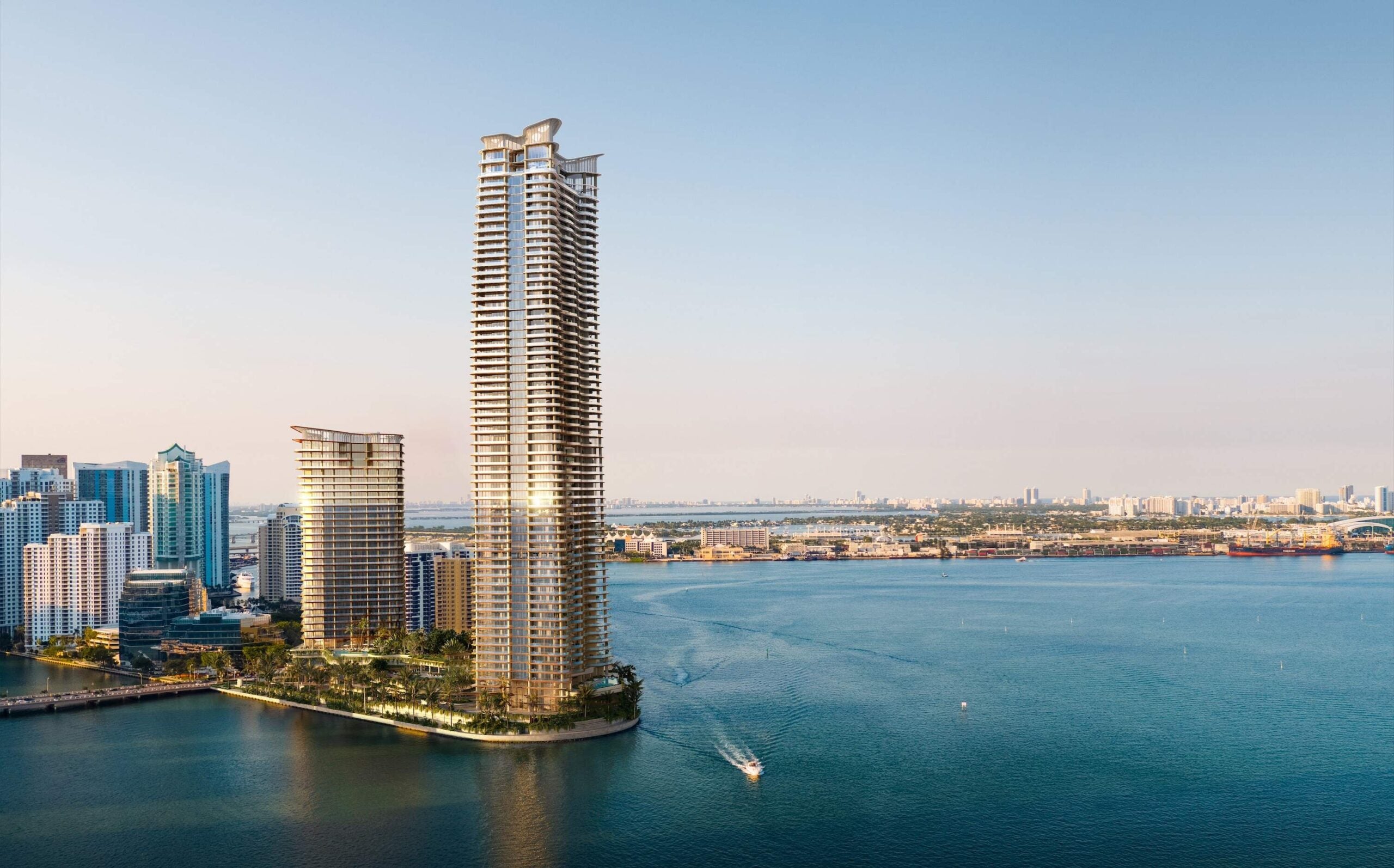
One enticing option for those seeking both a solid track record and a promising trajectory is branded residences. Already home to 33 such developments, the city has 32 new projects in the pipeline, according to the latest Savills figures. Ritz-Carlton is the area’s biggest player, with six existing buildings and nine more planned.
“We have seen incredible growth in our branded residences portfolio in South Florida,” says Dana Jacobsohn, chief development officer for US luxury brands at Marriott International, Ritz-Carlton’s parent company. “Sales momentum is excellent,” she says, citing the forthcoming Ritz-Carlton Residences, South Beach, currently selling off-plan, which has “yielded incredible reception in the market.”
Ritz-Carlton buyers are typically “ultra-high-net-worth individuals seeking prestige and privacy,” she says. Such individuals are, in effect, investing in a quality trademark. Branded residences in the US are typically valued at more than 30 percent above comparable non-brand developments. In other words, the brand itself commands a distinct premium that provides reassurance to investors in unpredictable times.
Establishment glow-up: Paris and Milan

Established European capitals have seen few luxury branded residence schemes. So the announcement by the Maybourne Group, owner of Claridge’s, that 2027 will see its first hotel in Paris, accompanied by 23 ultra-luxury homes, has caused Francophile hearts to flutter.
Knight Frank’s recent Residence Report also recommends Haven, “a discreet developer” poised to open “its first full-building development on rue de l’Université… in late 2026.” The report concludes: In a city where new development has long been constrained by heritage and bureaucracy, this small cluster of schemes could change the narrative.’ Over the five years to June 2025, prime Paris prices have grown by 13.7 percent.

In Italy, newcomers who become tax-resident benefit from a flat tax of €200,000 (just over $232,000) on annual foreign income. For Milan, this, combined with the upgrading of the city’s luxury infrastructure, has led to price strengthening of 7 percent in the 12 months to June 2025.
Milan has always lagged behind Italy’s other historic cities in terms of expat appeal, despite its fashion and design credentials and proximity to the Alps and Lake Como. But the 2021 opening of Casa Cipriani, the New York private members’ club and hotel, is seen as a turning point. “They feel that they’ve filled a niche,” says Bailey. For “people who are buying super prime property around the world,” Casa Cipriani brings “the same kind of infrastructure that you’d have in New York or in London.”
Related Story

