
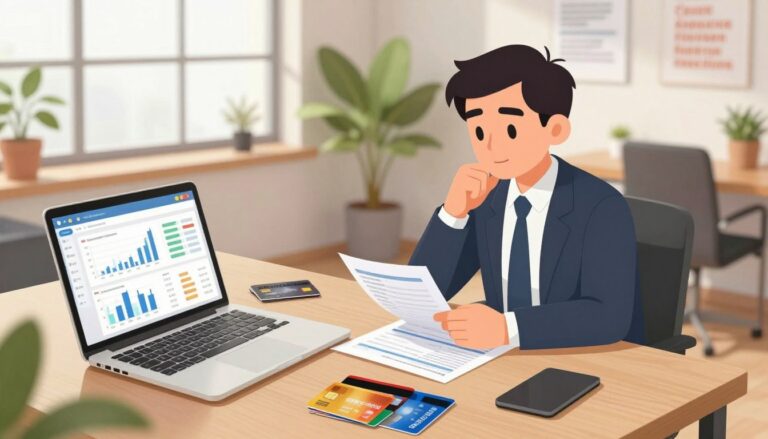
Staying in control of household finances starts with a few practical habits. Effective Credit Card Account Management helps people use rewards and convenience without extra stress.
They can set up automatic payments, track spending with a budgeting app, and review billing statements each month. These steps make it easier to avoid high-interest balances and missed due dates.
Financial experts say using a credit card responsibly builds a positive credit history over time. When maintained, these tools support long-term goals like buying a home or saving for college.
Keep payments on time. Monitor activity monthly.
Getting Started with Credit Card Account Management
Setting up online access is the first step toward using a new payment tool with confidence. It gives clear visibility into balances, recent activity, and upcoming due dates.
Setting Up Online Access
After receiving a new credit card, register for the issuer’s online portal right away. Registration unlocks your loan and bank information, statements, and alerts.
If help is needed, Synchrony Bank partners can call support at 1-800-333-1082 between 8 AM and 12 AM ET. CareCredit enrolled providers should use 1-800-859-9975 for specialized help.
Downloading the Mobile App
Install the issuer’s app to manage balances and monitor the account on the go. The app also lets users view the account number securely and set push alerts.
- Register online to track spending and review statements.
- Use support lines for fast assistance with profile or billing questions.
- Keep the app updated to protect sensitive information.
| Provider | Support Phone | Key Feature |
|---|---|---|
| Synchrony Bank | 1-800-333-1082 | Online portal & phone support (8 AM–12 AM ET) |
| CareCredit (enrolled providers) | 1-800-859-9975 | Provider-specific support for cards and billing |
| Issuer Mobile App | N/A | Balance checks, alerts, secure number display |
Essential Tools for Monitoring Your Spending
Quick, visual spending tools help people see where their money goes each month. Many issuers provide dashboards that sort purchases into clear categories. This makes it easier to spot high-use areas and stay under a chosen limit.
Using rewards programs adds value, but users should check that extra buys match their financial goals. They should also review their account statements to find any unauthorized charges quickly.
- Set up alerts by text or email to track activity in real time.
- Use digital dashboards to categorize spending and spot trends.
- Keep purchases within a planned limit to maintain healthy credit.
| Tool | Benefit | Best Use |
|---|---|---|
| Spending Dashboard | Auto-categorizes transactions | Monthly budgeting |
| Alerts | Immediate transaction notices | Fraud detection |
| Rewards Tracker | Shows points and offers | Maximizing perks |
Strategies for Making Timely Payments
A clear payment plan prevents surprises and protects your credit rating. Small steps each month add up and reduce costs over time.
Automating Your Monthly Bills
Automating payments removes the guesswork. It ensures people never miss a due date and avoids late fees or rate hikes.
- Set automatic transfers for the statement balance when possible.
- Schedule alerts a few days before the draft to verify funds.
Paying More Than the Minimum
Paying only the minimum extends debt and raises interest costs. When full payment is not possible, pay extra to lower the principal.
For example, a $500 laptop at 8% APR costs about $40 in interest over 12 months. The same purchase at 18% APR costs about $90. Choosing lower rates or paying more each month can save roughly $50 on that purchase.
Avoiding Finance Charges
To avoid finance charges, make payments in full by the due date whenever possible. If cash purchases are used, keep a plan to pay the balance at once.
- Automate monthly payments to prevent misses.
- Keep a consistent payment schedule to protect a loan history.
| Purchase | APR | Interest over 12 months |
|---|---|---|
| $500 laptop | 8% | $40 |
| $500 laptop | 18% | $90 |
Understanding Your Billing Statement Details
Reviewing the monthly statement helps spot errors and hidden fees fast. The paper or PDF contains key information that explains what was billed and why.
The statement includes the account number used for the file. Keep that number private to prevent others from using the credit card.
Each transaction line shows the date, merchant, and charge amount. It also marks any cash advances and related fees so users see when they took out cash.
- Check the payment coupon to confirm that payments post to the correct account and date.
- Look at the new balance to know the full amount due, including interest or fees from the prior cycle.
- Verify the statement closing date to learn when interest and fees were calculated for the billing period.
If a discrepancy appears, contact the issuer immediately to dispute the charge. Quick action helps protect the credit profile and prevents further unauthorized use.
| Statement Element | What to Check | Action If Wrong |
|---|---|---|
| Account number | Keep it secure; match last digits | Report loss to issuer immediately |
| Transaction lines | Date, merchant, amount, cash advances | Flag unfamiliar charges and dispute |
| New balance & due date | Total owed including interest | Schedule payment or set auto payment |
| Statement closing date | Interest calculation cutoff | Track purchases relative to cutoff |
Maintaining a Healthy Credit Utilization Ratio
Keeping balances low across available lines helps preserve a strong credit profile. A healthy utilization ratio usually sits between 10% and 40% of the total limit.
Impact on Your Credit Score
How much of the available borrowing is used affects the overall score. Lenders view lower utilization as a sign of responsible behavior.
If someone often maxes out a credit card, the score can drop even when payments are on time. The ratio is simple: divide the total balance by the total limit.
- Keep utilization between 10% and 40% to help improve the credit score.
- Closing an old card can raise utilization and lower the average account age.
- If spending stays high, request a higher limit or pay down balances more often.
| Action | Effect | Tip |
|---|---|---|
| Lower monthly balances | Improves score | Make multiple payments each cycle |
| Close old card | May harm score | Keep long-standing cards open if possible |
| Increase limit | Reduces utilization | Ask issuer or request a credit line increase |
Protecting Your Account from Fraud and Theft
A few small habits make it much harder for fraudsters to misuse someone’s financial information. Shredding unwanted offers and unopened mail stops many ID thieves before they get started.
They should never share an account number or personal number over email or phone unless the call was initiated by them. If suspicious activity appears, contact the issuer right away to freeze the card and dispute any unauthorized charge.
- Shred or cut offers and sensitive mail into small pieces to prevent identity theft.
- Report a lost or stolen card immediately so the issuer can block further use.
- Use built-in fraud protection that freezes a card when spending exceeds a usual limit.
- Monitor statements and alerts to spot unfamiliar charges or cash withdrawals quickly.
| Action | Immediate Effect | Who to Call |
|---|---|---|
| Shred offers | Reduces mail-based identity theft | — |
| Report lost card | Blocks access and prevents new charges | Issuer support line |
| Freeze after fraud | Stops further unauthorized charges | Issuer dispute team |
Staying vigilant preserves rewards and convenience while lowering theft risk. For details on fees and protections that affect fraud response, see common fees at common fees.
Conclusion
A steady routine of checking alerts and paying on time prevents common financial slips. Simple habits reduce stress and keep balances under control.
They should watch spending, read each statement, and keep utilization low to protect their score. Use mobile apps and automated payments to simplify tasks and spot problems early. Protect personal data and report suspicious activity right away.
When used carefully, a payment product can deliver useful rewards and security for everyday purchases. Reading terms and planning payments makes it easier to enjoy benefits while avoiding pitfalls.