
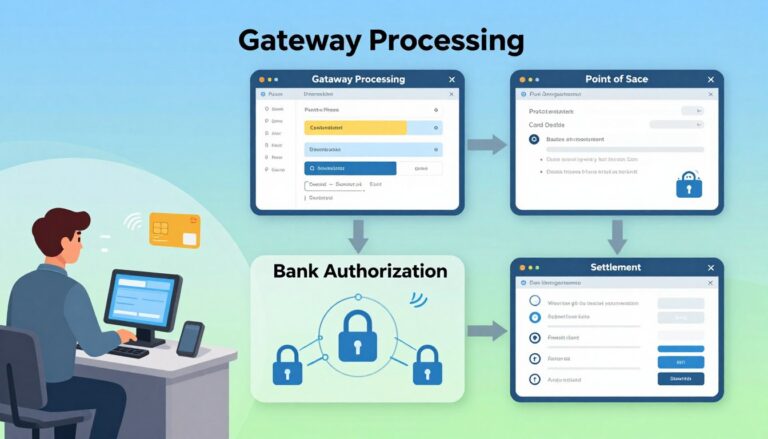
Understanding how a credit card payment moves from a customer to a business helps owners choose the right provider. The process runs fast, but it hides several key steps that move data and funds between the cardholder, merchant, issuing bank, acquiring bank, and networks.
When a customer pays, systems validate the account and check for fraud. Authorization, clearing, and settlement work together to confirm details and send funds.
Most processing takes seconds, though banks may take one to five business days to post funds. Knowing these steps helps merchants manage processing fees, reconcile accounts, and pick a processor that fits their sales volume.
Small and mid-size businesses benefit from reliable payment tools and secure networks. Clear steps and strong security protect customers and help businesses deliver goods and services with confidence.
Understanding the Credit Card Transaction Stages
Behind every quick swipe or tap is a short, defined process that confirms funds and prevents fraud. This process has three main parts: authorization, authentication, and clearing and settlement.
First, authorization asks the issuer and the network for permission. The issuing bank checks the account and available credit in seconds. If approved, the merchant gets a hold on the amount.
Next, authentication verifies the cardholder and looks for fraud using security tools. Tokenization, CVV checks, and real-time fraud scoring help protect customers and businesses.
Finally, clearing and settlement post the entries to both the customer’s and the merchant’s accounts. Banks and the card network exchange data so funds move and statements update.
- Authorization: permission request and fund hold.
- Authentication: identity checks and fraud prevention.
- Clearing & settlement: posting and fund transfer.
| Step | Purpose | Typical Time / Impact |
|---|---|---|
| Authorization | Verify account and reserve funds | Seconds; prevents declines at point of sale |
| Authentication | Confirm cardholder and detect fraud | Seconds; reduces chargebacks and fraud risk |
| Clearing & Settlement | Post entries and move funds between banks | Same day to a few business days; affects cash flow and fees |
Key Participants in the Payment Ecosystem
Multiple entities collaborate to move funds and data from a buyer to a seller in every modern payment. Each role handles discrete duties that keep processing fast and secure.
Cardholder and Merchant Roles
The cardholder owns the payment account and starts the purchase for goods or services. They present payment details at a point of sale or online checkout.
The merchant accepts payments and runs a merchant account to receive funds. Point-of-sale systems or online gateways capture the sale and forward information to the processor.
Financial Intermediaries
Issuing banks provide credit and decide approval or decline during authorization. The acquiring bank holds the merchant account and helps settle funds after processing.
- Payment processors and gateways transmit data between the merchant and the card network.
- Major networks like Visa and Mastercard set rules and interchange fees across the system.
- All participants focus on security, fraud checks, and timely settlement to protect customers and businesses.
| Participant | Primary Role | Key Impact |
|---|---|---|
| Cardholder | Initiates purchase | Provides authorization and payment details |
| Merchant | Accepts payments | Delivers goods services and manages the merchant account |
| Issuing Bank | Provides account and approves charges | Handles authorization and customer billing |
| Acquiring Bank | Maintains merchant account | Facilitates settlement and credits the business |
The Authorization Phase
The authorization phase is the quick check that confirms a payment can proceed. It begins when the merchant sends the credit card payment details from a gateway or terminal to the processor.
The processor forwards the request to the acquiring bank. The acquiring bank routes the data through the card network to the issuing bank for approval.
The issuing bank verifies the cardholder and checks the account for available funds. It then sends an approval or decline code back through the same path to inform the business.
- Merchant sends payment details to the acquiring bank to start the request for funds.
- The card network routes the data to the issuing bank for verification.
- The issuing bank checks validity and available funds, then returns an approval or decline.
- Approval arrives in seconds, letting the merchant complete the sale without delay.
| Step | Who Handles It | Why It Matters |
|---|---|---|
| Request routing | Processor → Acquiring bank → Card network | Ensures data reaches the issuing bank for approval |
| Issuer check | Issuing bank | Verifies cardholder identity and available account funds |
| Response | Network → Processor → Merchant | Approval or decline lets the business finalize the sale |
Authentication and Security Checks
Strong authentication and layered security keep fraud out while legitimate purchases flow smoothly. These checks confirm the person using the account and verify billing details before funds move.
Fraud Prevention Tools
The issuing bank uses Address Verification Service (AVS) to match the billing address with on-file data. This step helps prevent mismatches during payment processing and lowers risk for both the processor and the merchant.
EMV chip terminals add a hardware layer of protection that reduces the chance of stolen information from magnetic stripe skimming. For remote sales, confirming the CVV is a simple, effective check for phone and online orders.
- Authentication verifies the cardholder’s identity before finalizing the sale.
- Advanced tools, like Stripe Radar, cut fraud disputes by roughly 38% through machine learning and rules.
- Using AVS, CVV checks, and EMV together lowers chargebacks and protects the merchant account.
| Tool | Purpose | Impact |
|---|---|---|
| AVS | Match billing address | Reduces false approvals and fraud risk |
| EMV | Secure chip authentication | Prevents card data cloning |
| Fraud Radar | Behavioral scoring and rules | Fewer disputes and lower fraud losses |
Clearing and Settlement Procedures
Clearing and settlement tie up the loose ends after a sale, turning approvals into actual deposits. At day end, the merchant batches approved sales and sends the file to the acquiring bank for processing.
The card network routes each record to the issuing bank so the issuer can clear the items. After approval, the issuing bank sends funds to the acquiring bank, usually within 24 to 48 hours, minus the interchange fee.
The acquiring bank then credits the merchant account, less the merchant discount. This full settlement typically posts in one to five business days, depending on the processor and bank schedules.
- Clearing moves authorization data through the network for posting.
- Settlement is the actual transfer of funds between banks and the merchant account.
- Efficient clearing helps a business predict when funds and reports will arrive.
| Process | Who | Timing |
|---|---|---|
| End‑of‑day batching | Merchant → Acquiring bank | Same day |
| Network routing | Card network | Seconds to hours |
| Issuer transfer | Issuing bank → Acquirer | 24–48 hours |
| Merchant credit | Acquiring bank | 1–5 business days |
Breakdown of Processing Fees and Costs
A clear view of how fees break down helps businesses spot savings and negotiate better terms.
Interchange Fees
Interchange fees are set by the major networks and usually form the largest portion of the bill. They commonly range from about 1.5% to 3.5% of the sale amount.
These rates go to the issuing bank to cover risk and rewards tied to the account. For merchants, interchange is the non‑negotiable base cost for accepting payments.
Assessment Charges
Assessment charges pay the card networks for operating the system. They are smaller fixed percentages or flat cents per sale.
They help fund network infrastructure and rule enforcement. Businesses cannot negotiate these network fees directly.
Processor Markups
The processor markup is the fee the merchant service provider adds for routing, support, and services. This portion is often negotiable.
Knowing the pricing model—interchange‑plus or flat‑rate—lets a business compare true costs. High-volume sellers usually save most by choosing interchange‑plus pricing and negotiating the markup.
- Total cost = interchange + assessment + processor markup.
- Interchange is typically the largest expense.
- Processor markups are the area most open to negotiation.
| Fee Type | Who Receives It | Typical Size |
|---|---|---|
| Interchange | Issuing bank | 1.5%–3.5% of sale |
| Assessment | Card network | Small percentage / fixed cents |
| Processor markup | Merchant provider | Negotiable; varies by service |
Managing Chargebacks and Payment Disputes
A single contested purchase can trigger fees, hold funds, and begin a lengthy representment cycle. A chargeback happens when a customer disputes a credit card transaction with their issuing bank.
When that occurs, the issuer debits the amount and applies a fee from the merchant account. Typical chargeback fees range from $10 to $35 per dispute.
Merchants can fight a dispute through representment by supplying evidence, such as a signed receipt, shipping records, or order data. The process can take up to 90 days to resolve.
- Respond quickly to reduce lost funds and extra fees.
- Keep clear records of all credit and card sales to support representment.
- Choose a processor that offers dispute management to streamline responses.
| Issue | Impact | Recommended Action |
|---|---|---|
| Customer dispute | Debit from merchant account; possible fee | Gather receipt, delivery proof, and correspondence |
| Chargeback fee | $10–$35 per case | Prevent with clear policies and receipts |
| Excessive disputes | Higher processing rates or account termination | Monitor account, train staff, and improve fraud checks |
Selecting the Right Payment Processor
Picking the right processor can lower costs and simplify how a business accepts payments. The choice affects day‑to‑day operations, reporting, and how quickly funds hit the merchant account.
Evaluating Integration and Support
First, check if the provider connects with the point‑of‑sale and online store tools already in use. Seamless integration reduces errors and speeds reconciliation.
Look for reliable support that answers questions fast. Twenty‑four‑seven assistance helps resolve issues that block sales or delay access to funds.
- Helcim: interchange‑plus pricing with a virtual terminal and POS tools.
- Square: flat‑rate fees and turnkey website and POS integration.
- Stripe: flexible API for custom online payment processing.
- Clover: full POS suites for retail and restaurants.
- Stax: subscription pricing that can lower costs for high volumes.
| Need | What to check | Why it matters |
|---|---|---|
| Integration | Native plugins, API access | Saves time and reduces errors |
| Pricing | Flat‑rate vs interchange‑plus | Impacts long‑term fees |
| Support | 24/7 help, demo accounts | Minimizes downtime and risk |
| Security | PCI DSS, tokenization | Protects customers and the merchant account |
Conclusion
Clear procedures around payment handling give businesses control over cash flow and risk. They help teams respond fast to issues and keep daily operations steady.
Mastering authorization, clearing, and settlement reduces delays and costly errors. Managing fees and disputes protects the merchant account and preserves margins.
Choosing the right processor and staying current with credit card and card processing trends lets a business scale with confidence. A well‑run system supports growth and improves the buyer experience in today’s digital market.