
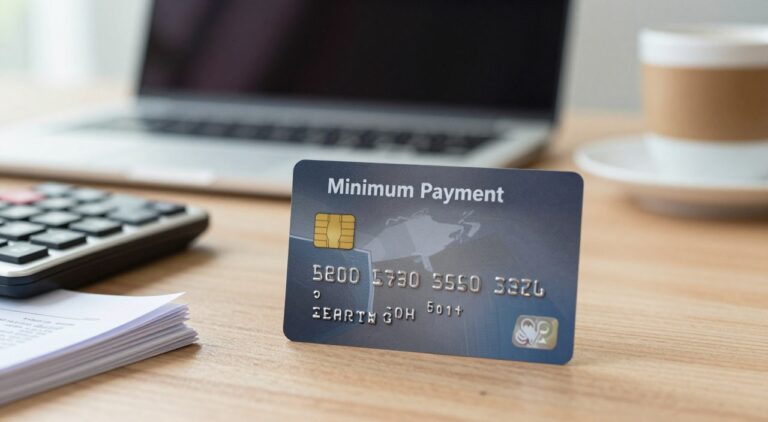
Understanding a minimum payment helps a person keep a credit card account in good standing with their issuer. It is the smallest payment due each month that prevents late fees and keeps billing terms intact.
When a balance carries over, interest and other charges make the debt grow with time. Paying only the card minimum can stretch repayment and raise total fees.
Federal rules require clear notices about the amount due and the percentage rate used to calculate a card minimum payment. By making at least that payment each month, a person protects their credit score and avoids penalty rates that harm standing with lenders.
Understanding How Minimum Payments Work on Credit Cards
Issuers set a required payment each billing cycle that preserves account standing but may not stop interest. This required payment is the smallest amount due to avoid late fees and negative reporting.
Defining the required amount
The minimum payment is often a small percentage of the total balance, typically between 1% and 2% of what is owed. It is not the same as the full statement balance or the current balance that may include recent charges.
Statement balance versus current balance
The statement balance shows charges from the last billing cycle. The current balance is the total owed at any moment, including new activity.
- Paying the minimum prevents late fees but allows interest to accrue on the remainder.
- Choosing to pay only the minimum extends repayment time and increases total debt.
- Keeping up with the required amount helps preserve credit score and good standing with the issuer.
The Role of Minimum Payments in Account Standing
Meeting the monthly required amount protects the account from penalty rates and helps preserve a positive record.
Paying the minimum payment by the due date keeps the account listed as current. That avoids late fees and stops issuers from reporting delinquency to bureaus.
Making on-time payments builds payment history, which fuels about 35% of a credit score. A steady record of timely payment makes it easier to get better terms later.
Still, paying only the minimum does not reduce the balance quickly. Interest keeps adding to the remaining debt and slows progress in lowering credit utilization.
Treat the card minimum payments as a short-term safety net, not a plan for full repayment. Whenever possible, pay more than the stated amount to cut interest and shrink the balance faster.
| Action | Short-term effect | Long-term effect |
|---|---|---|
| Pay minimum | Account stays current; no late fee | Debt shrinks slowly; interest accumulates |
| Pay full statement | No interest charged | Faster debt reduction; lower utilization |
| Miss payment | Late fee; possible reporting | Score damage; higher penalty APR |
How Issuers Calculate Your Minimum Amount
Your issuer follows specific formulas to turn a balance into the required monthly payment. These rules appear in account terms and vary by company.
Common calculation methods
Most credit card issuers set the minimum payment as a small percentage of the balance, often between 1% and 2%. They then add any accrued interest and fees to that figure.
- Some firms use a flat dollar amount, for example $25, when balances are low.
- Past-due amounts or installment plan charges can be added by the issuer to that month’s required amount.
- Understanding the formula in your account terms helps avoid surprise fees and late reporting.
| Method | Typical result | When used |
|---|---|---|
| Percentage of balance | 1%–2% plus interest | Most revolving accounts |
| Flat dollar | Set amount (e.g., $25) | Low balances or specific products |
| Mixed formula | Greater of flat or percent | Many mainstream card accounts |
Locating Your Payment Information
Accessing your next required payment is simple: check your credit card statement or log into your online account.
You can find the minimum payment amount and the due date on a mailed bill or inside the issuer’s portal. Most issuers also show the current balance and any pending charges there.
Modern mobile apps make this faster. A customer can tap the app to confirm the amount required to keep an account good and to see the full billing history.
- View the next payment amount and due date on paper statements or the online dashboard.
- Use your issuer’s mobile app to check balance, verify card minimum payment, and set alerts.
- Capital One customers can sign into the Capital One mobile app or website to see these details anytime.
- Review the statement monthly so new charges or interest do not change the amount unexpectedly.
| Where to look | What it shows | Why it matters |
|---|---|---|
| Paper billing | Due date, minimum payment | Official record for payments |
| Online portal | Current balance, amount due | Quick updates and history |
| Mobile app | Alerts, card minimum payment | Convenient reminders to keep account good |
The Impact of Minimum Payments on Interest Accrual
Small monthly payments can let interest compound quickly, turning a modest balance into long-term debt. This section explains two key effects: how interest compounds and how utilization affects credit performance.
Compounding Interest Effects
When a cardholder pays only the stated amount, most of that payment often covers interest and fees. The principal shrinks slowly, so interest in the next cycle is calculated on a nearly unchanged balance.
- Interest compounds each billing cycle, increasing the total amount owed over time.
- Paying more than the minimum reduces principal faster and cuts future interest charges.
Credit Utilization Ratios
High credit utilization harms a credit score and signals greater risk to lenders. Carrying large balances while paying the least amount raises the utilization ratio and can lower a score over months.
| Effect | Short-term | Long-term |
|---|---|---|
| Paying minimum | Account current; interest grows | Higher debt; slower payoff |
| Reducing balance | Lower utilization | Improved score; less interest |
| New purchases while carrying debt | Balance rises | Greater fees and stress |
Understanding the Minimum Payment Warning
The credit card statement includes a federally required minimum payment warning that shows the true cost of paying only the smallest monthly amount.
This notice lays out a table that projects how long it will take to clear a balance and how much total interest the account will incur if the cardholder keeps making just the stated payment.
Issuers must show what monthly figure would be needed to repay the balance within 36 months. The goal is to make the long-term impact of paying minimums easy to see.
- The warning compares the pay-off time and total cost for different scenarios.
- It highlights the amount of interest added over the life of the debt when paying minimums.
- Seeing the totals often motivates people to pay more than the card minimum to reduce cost and debt length.
| Scenario | Payoff time | Total interest |
|---|---|---|
| Only the minimum payment | Often decades or longer | High cumulative interest |
| Pay to clear in 36 months | 36 months | Moderate interest |
| Pay more than minimum | Shorter term | Lower interest |
Consequences of Missing a Scheduled Payment
A missed due date can trigger immediate consequences from an issuer and change a borrower’s cost of credit.
Missing a minimum payment can cause a late fee and may push the account into a penalty APR. That higher rate raises interest and makes the balance harder to reduce.
Penalty APR and Credit Reporting
If a payment is 30 days or more late, bureaus such as Experian, Equifax, and TransUnion can receive a negative mark. Payment history drives about 35% of a credit score, so a single missed amount can lower the score noticeably.
- Late fee plus possible penalty APR from the card issuer.
- Loss of the grace period; interest may start accruing on new purchases immediately.
- Possible need for six months of on-time payments to regain a standard rate, per the issuer’s rules.
- Consistent on-time payments help keep account good and protect credit utilization and history.
| Event | Short-term effect | Long-term effect |
|---|---|---|
| 30+ days late | Late fee; reported to bureaus | Lower score; higher cost of borrowing |
| Penalty APR applied | Higher interest | Slower balance paydown; more fees |
| Multiple on-time months | Improving record | May restore normal rate and standing |
Strategies for Reducing Your Monthly Minimum
They can lower the future minimum payment by cutting the principal that the issuer uses in its percent-based formula.
To cut interest and shrink the monthly obligation, prioritize extra principal payments when possible. Avoid new purchases that raise the balance and push the payment higher.
- Pay extra toward principal to reduce the percentage-based calculation used by the issuer.
- Use a balance transfer with a 0% introductory APR to stop interest and focus on payoff.
- Work with a nonprofit credit counselor to set up a debt management plan if balances are large.
- Ask the issuer about hardship programs for temporary relief during tight months.
| Strategy | Short-term effect | Best for |
|---|---|---|
| Extra principal | Lower payment next cycle | Anyone with spare cash |
| 0% balance transfer | Zero interest for promo period | Larger balances with good score |
| Debt counseling | Structured payoff; possible lower fees | Severe debt and multiple accounts |
Small changes can cut fees and speed payoff. A clear plan helps the person make minimum payment choices that reduce long-term cost and stress.
Managing Your Debt Beyond the Minimum
Tackling balances beyond the stated monthly obligation speeds payoff and cuts total interest paid. Paying more than the minimum payment each month is the single best move to lower long-term cost.
Making several payments during the month lowers the average daily balance. That reduces the interest that accrues and shortens the time to clear a credit card balance.
- Pay extra toward principal to shrink the balance faster and reduce fees.
- Keep the credit utilization ratio low—it counts for about 30% of a credit score.
- Focus on high-interest accounts first to save the most over time.
| Action | Short-term | Long-term |
|---|---|---|
| Pay only the card minimum | Lower monthly outflow | Higher interest; longer payoff time |
| Pay more each month | Faster principal reduction | Less interest; better score |
| Multiple payments per month | Lower average balance | Saves interest; speeds payoff |
Conclusion
Seeing the true cost of carrying a balance often prompts better payment choices and faster payoff. Keeping an account good standing matters for future borrowing and peace of mind.
Making at least the minimum payment keeps a credit card active, but it rarely speeds repayment. Paying more lowers the balance faster and cuts interest over time.
Review statements regularly to track rates, fees, and due dates. Small extra amounts each month reduce long-term cost and improve overall credit health.
By taking control of card payments today, a person can avoid needless fees and move toward a debt-free future with greater confidence.