
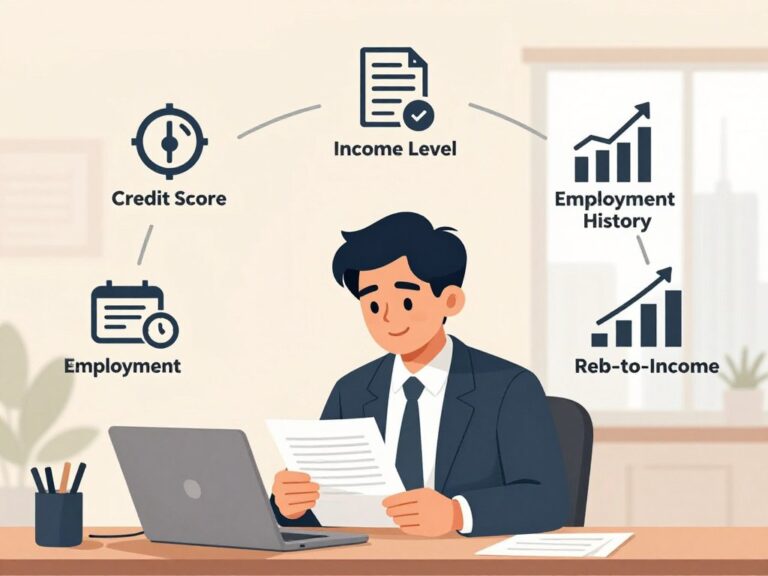
When someone applies for a personal loan, the lender checks a few clear markers to decide if the personal loan application will be approved. Lenders look at credit history and credit score to gauge how reliably the borrower repays debts.
Income and employment stability matter next. A steady paycheck or reliable self-employment record makes it easier to meet basic requirements and win approval from a lender.
Different lenders set different bars. Some favor high credit scores, while others offer options for people with lower scores. Researching which loans match a financial profile helps avoid denied applications.
Understanding these factors is the first step to getting an approved personal loan. Applicants who review credit, income, and lender requirements can better prepare and improve their chances of success.
Understanding What Affects Loan Eligibility
Lenders review several personal and financial signals before deciding whether to extend credit. They focus on credit history and documented income to set rates and terms for a personal loan.
Before beginning an application, borrowers should make sure debts are current and payment records are clean. Most lenders ask for paystubs or tax returns to confirm income and job stability.
Underwriters also check the debt-to-income ratio to see if the applicant can afford new monthly payments. Meeting the basic requirements increases personal loan eligibility and helps applicants qualify personal requests more easily.
- Credit score and assets influence interest rates and terms.
- The lender reviews on-time payments and current account status.
- Documentation and steady work history speed approval.
Comparing offers from several lenders and preparing required paperwork makes it simpler to get approved. Solid records, verified income, and clear requirements help people secure the loans they need.
The Role of Credit Scores in Approval
A single number on a credit report often shapes how lenders price and approve a personal loan. This score gives lenders a fast signal about repayment behavior and overall risk.
Credit Scoring Ranges
Scores below the low 600s are usually viewed as fair or poor. Borrowers in that range often face stricter options and higher costs.
Good or excellent scores typically start around 670 and above. Many lenders set firm minimums in the 600s, so reaching that mark improves access to better loans.
- Two to three years of credit history is commonly reviewed by underwriters.
- A mix of accounts and on-time payments strengthens credit profiles.
- Checking the report for errors can remove unfair negatives like outdated items.
Impact on Interest Rates
Lenders use risk-based pricing: higher scores usually mean lower interest and friendlier terms. Lower scores increase interest to cover added risk.
Borrowers with strong credit often secure the best annual percentage rates on a personal loan. Those with lower marks may see shorter terms or higher monthly costs.
Evaluating Your Payment History
Lenders often weigh past payment behavior as the strongest signal of future repayment.
Your payment history is one of the biggest factors that shapes a credit score. A steady record of on-time debt payments tells lenders how likely someone is to repay a personal loan.
Missing payments can stay on a credit report for up to seven years, so it helps to bring past due balances current before starting a loan application. Once accounts are current, setting up automatic bill pay or reminders makes it easier to keep payments on time.
- Check the credit report for errors at AnnualCreditReport.com or consumer sites like NerdWallet.
- Prioritize clearing past due balances to show improvement to lenders.
- Use autopay or alerts to guard against accidental late payment on any account.
- Consistent on-time payments over months strengthen the credit score and improve chances for better loan offers.
How Income Requirements Influence Decisions
Underwriters focus on documented income to judge whether monthly payments fit a borrower’s budget. Income helps the lender estimate the borrower’s capacity to repay and the amount they can safely borrow.
The lender often asks for proof to verify monthly income and to check steady cash flow. Some firms set clear minimums: Avant requires about $1,200 in monthly income, while Discover asks for roughly $25,000 per year for a personal loan.
Acceptable Sources of Income
Lenders accept paychecks, self-employment receipts, and retirement or Social Security payments when assessing income. Alimony and certain investments can count too.
- Verifying documents may include pay stubs, W-2s, or recent tax returns.
- If income is irregular, the borrower may need extra proof to substantiate cash flow.
- Listing every income source gives the lender a complete view for eligibility.
| Lender | Minimum Income | Common Proof Requested |
|---|---|---|
| Avant | $1,200 monthly income | Recent pay stubs, bank statements |
| Discover | $25,000 annual income | W-2s, tax returns |
| Typical Regional Bank | Varies by amount requested | Two recent pay stubs, proof of benefits |
Managing Your Debt to Income Ratio
The debt-to-income ratio shows how much of each paycheck already goes toward existing obligations. It is a key metric lenders use when reviewing a personal loan or other credit requests.
To calculate DTI, add monthly debt payments and divide that sum by gross monthly income. Lenders typically prefer a DTI around 36% or less. If the ratio rises above 40%, some lenders may flag the borrower as higher risk.
Lowering DTI improves loan eligibility. Pay down credit balances, avoid new credit card charges, and focus on larger payments with the highest interest. Bringing past balances down before applying makes a clear difference.
- Include only recurring debt payments in the DTI calculation, not most utilities or insurance.
- Target a DTI under 36% to increase approval odds for personal loan requests.
- Track progress and recheck a credit report before submitting applications to lenders.
Essential Documentation for Your Application
Before the application moves forward, borrowers must gather specific documents that prove who they are and how they earn money.
Proof of identity is usually a government-issued ID. Examples include a state driver’s license or a passport. Lenders may also ask for the Social Security number or ITIN to run a credit report.
Verification of income
Income proof shows the lender the borrower can repay. Common proofs are recent pay stubs, W-2s, or the last two years of tax returns for self-employed applicants.
Include any additional sources such as alimony, child support, or retirement payments if they help qualify. Gathering these items ahead of time speeds processing time.
Residency requirements
Proof of residence confirms the applicant lives where they say. A utility bill, lease, or bank statement usually suffices.
- Be at least 18 and provide a working phone or email for contact.
- Some lenders may require U.S. citizenship, permanent residency, or membership if applying through a credit union.
| Document Type | Common Proof | Why it matters |
|---|---|---|
| Identity | Driver’s license, passport | Verifies who the applicant is for the account |
| Income | Pay stubs, W-2s, tax returns | Shows stable cash flow to repay loans |
| Residency | Utility bill, lease, bank statement | Proves address where lender can reach the applicant |
Considering Collateral for Secured Loans
Secured borrowing ties a specific asset to the agreement, changing how underwriters view risk.
A secured personal loan is backed by property such as a car or a savings account used as collateral. This backing can lower interest and increase the amount available compared with unsecured options.
Most personal loans remain unsecured, so many lenders do not require assets. However, offering collateral can help an applicant with poor credit qualify for better terms and lower rates.
- Collateral reduces lender risk and can improve pricing.
- Accepted items include vehicles, investment accounts, or cash in a savings account.
- Failure to repay lets the lender claim the pledged property.
| Type | Typical rates | Risk to borrower |
|---|---|---|
| Secured | Lower interest | Asset at risk |
| Unsecured | Higher interest | No property pledged |
Strategies to Boost Your Approval Odds
Practical steps can raise a borrower’s odds of approval without waiting years for credit score shifts.
Start by reviewing the credit report for errors. Fixing mistakes can improve the score quickly and help an application look cleaner to lenders.
Lowering DTI matters. Pay down balances or increase income to reduce the debt ratio. A smaller ratio makes monthly payments feel more manageable to a lender.
- Add a co-signer or co-borrower with strong credit and income to increase approval chances and get better rates.
- Pre-qualify with multiple lenders to compare estimated APRs without harming the credit score.
- Request higher card limits or become an authorized user to lower credit utilization and build scores over time.
- Keep the requested amount modest; large amounts can raise red flags and hurt approval odds.
- Know origination fees; they often range from 1% to 10% of the amount and affect the true cost of a personal loan.
| Strategy | Primary benefit | Why it matters |
|---|---|---|
| Add co-signer | Better approval odds | Offsets weak credit or low income for lenders |
| Lower DTI | Stronger application | Shows capacity for new payments |
| Pre-qualify | Compare rates | No hard pull until you apply |
Navigating Denied Loan Applications
A denied application is often a clear signal of what needs work. Under the Equal Credit Opportunity Act, lenders must give a reason. That information points to practical fixes.
Steps to Take After Rejection
First, review the lender’s explanation and the credit report. Check for errors in accounts, late entries, or wrong balances. Dispute any mistakes promptly.
- Strengthen the credit score by paying down high-interest debt and making timely payments.
- Avoid multiple new credit requests. Too many inquiries in a short time can harm future approval odds.
- Consider a co-borrower or co-signer if income or score caused the denial.
- Recalculate dti and focus on lowering the ratio before reapplying; small payment changes can matter.
- Use the lender’s feedback to create a checklist of requirements to meet before applying again.
Improvement can take months or longer. Track progress with updated reports and only reapply when the account, payment, and score trends show real gains.
Exploring Financing Alternatives
If monthly cash is tight, several short-term financing routes can fill gaps without waiting to rebuild credit. These options can help cover a specific amount or bridge pay periods while avoiding long approval timelines.
Buy now, pay later plans often split a purchase into four biweekly payments with little or no interest. Many merchants provide this at checkout, making it an easy alternative to taking out a personal loan.
Cash advance apps let someone access a few hundred dollars between paychecks. They move quickly but can charge fees that translate to a high effective rate.
- Consider a 0% balance transfer card for a short-term purchase to avoid interest if you can pay within the promo window.
- Borrowing from family can offer flexible terms and lower interest than many lenders, but put agreements in writing.
- Build savings or earn extra income to reduce the amount you must borrow and improve future chances to qualify personal products.
- Avoid payday or auto title loans; their triple-digit APRs and asset risk make them costly choices.
Compare total costs across options — interest, fees, and any effect on credit — before choosing. Researching providers and reading terms helps find the most affordable path for specific needs.
Conclusion
Small, consistent moves to strengthen credit and income records help applicants present a stronger case to lenders.
By watching payment history, lowering debt-to-income ratios, and fixing report errors, they improve personal loan eligibility and the odds of approval.
Comparing rate offers and required terms across lenders uncovers the most affordable path. If an application is denied, follow the lender’s reasons and address those gaps before reapplying.
Building credit takes time, but steady progress leads to better access, lower costs, and more control when borrowing in the future.