

In late October, dozens of federal law enforcement officers flooded Canal street, a busy thoroughfare in Manhattan, arresting street vendors. Some officers donned full military uniforms; some wore plain clothes, baseball caps, and neck gaiters pulled over their faces. All were equipped with tactical vests of various styles and with a medley of identifying patches—“HSI,” “Customs and Border Patrol,” “Federal Agent,” or, simply, “Police.”
They wore markers of power and authority, but with little consistency across them. As news of the raid unfolded, the NYPD released a statement on X saying it had no involvement with the operation. So who, exactly, were all the people with “Police” emblazoned on their chests?
Every decade has its era-defining garments. Think spaghetti strap dresses in the 1990s, low-rise jeans in the 2000s, and athleisure in the 2010s. This year, one garment felt suddenly ubiquitous: the tactical vest. And it’s not just law enforcement wearing this gear; there’s a growing consumer market for body armor and garments that resemble them. They’ve gone from technical gear designed for professionals to normalized accessories. Moreover, these objects have seeped into fitness in the form of weighted vests that are made by the same companies who produce tactical gear. Their form factor has become a chilling symbol of a political climate defined by fear.
How the plate carrier mainstreamed
These vests, also known as plate carriers, are military equipment designed to protect the people who wear them from bullets and other ballistics. They’re garments with removable ceramic, steel, and composite plates, and are outfitted with nylon loops and Velcro that enables wearers to attach gear and accessories, a system known as MOLLE, an acronym for “modular lightweight load-carrying equipment.
What began as specialized garments created for active combat has been steadily infiltrating our cities for decades. The vests became more prevalent after the expansion of the 1033 program, which authorized the free transfer of surplus military equipment to local law enforcement for the War on Drugs in the 1980s and 1990s and counterterrorism post-9/11.
One interesting part of the business of these garments is that until the War on Terror, tactical clothing wasn’t something military actively stocked in the same way as guns and ammunition, explains Charles W. McFarlane, a military fashion historian and author of the Substack Combat Threads.
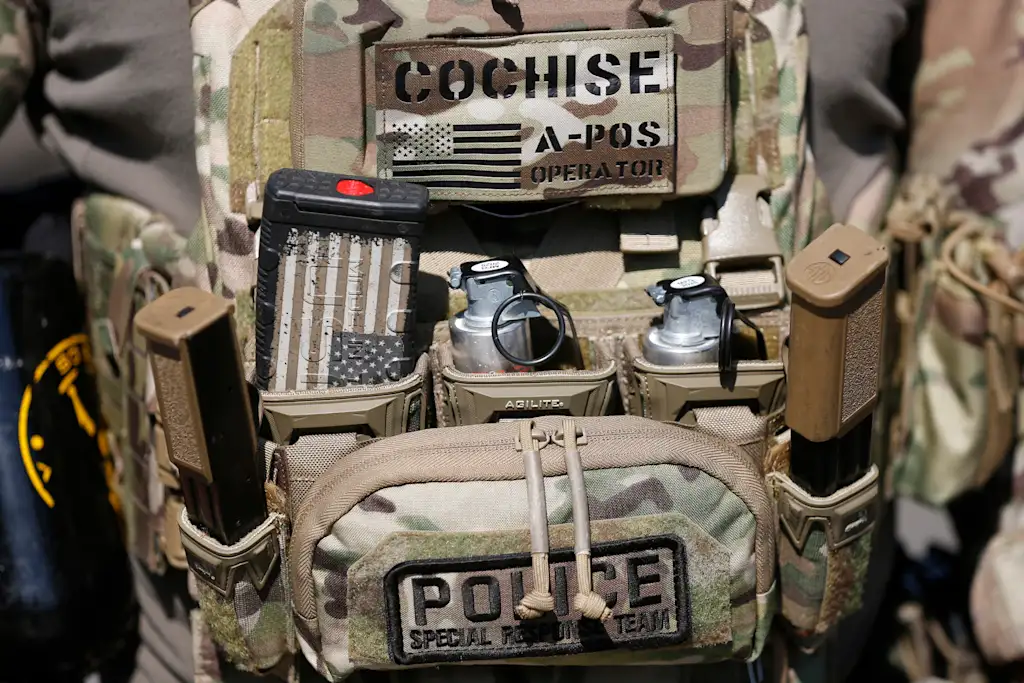
While body armor had been used since WWII, it took decades to create something that was protective but didn’t interfere with movement. Patrol troops in Vietnam, for example, didn’t regularly wear it because it was heavy, cumbersome, and trapped heat; however, troops in defense positions and on unarmored convoys did.
After Kevlar was invented in 1965, protective vests became lighter and easier to wear as designers integrated the material into gear. In the 1980s, the U.S. army began issuing Kevlar vests to some troops in the Middle East, Panama, and Grenada. Then in the 1990s, Army Rangers in Somalia wore vests with a combination of Kevlar and a hard plate.
In 1999, the military began issuing what most closely resembles the tactical vests of today, with removable plate inserts and the MOLLE system on the outside. But it wasn’t until 2003 that all soldiers received “one suit of body armor” as a matter of policy. McFarlane notes that the CIA paramilitary officers who led Operation Jawbreaker, the agency’s highly secretive first mission to Afghanistan in 2001, bought their gear at REI. “They look like they’re dads on a fishing trip,” McFarlane says.
As a new market for this gear opened, private companies began to develop specialty products that they sold to the military and the public, too. Brands like Crye Precision, 5.11 Tactical, and Safariland provide gear to the government and consumers. According to Research and Markets, the military Personal Protective Equipment (PPE) market—a category that includes body armor, tactical vests, and combat helmets among other products—is expected to see an annual growth rate of 8.2%, rising from $19.4 billion in 2024 to $29 billion in 2029.
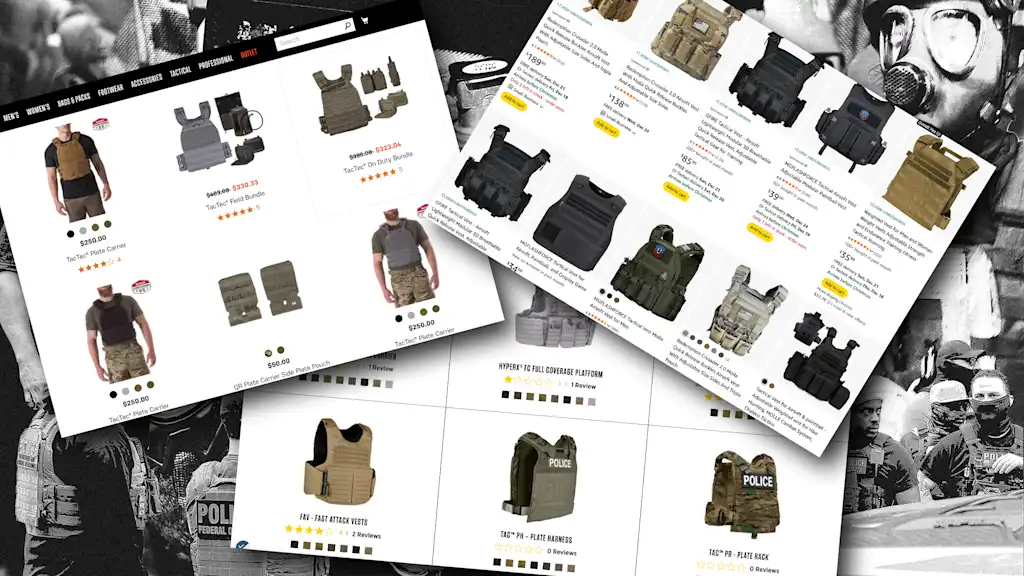
“This stuff has just become so much more available, and if you wanted to buy a plate carrier that is standard issue for the military or one that is used by Special Forces, you can go to the same companies and buy it, with some exceptions,” McFarlane says.
There are few sales restrictions on tactical gear. At the federal level, it’s illegal for people with felony convictions to buy plate carriers or body armor, but sellers say enforcement is lax. Some states have stricter rules, like New York, which passed a law in 2022 barring sales to anyone who isn’t in law enforcement or the military.
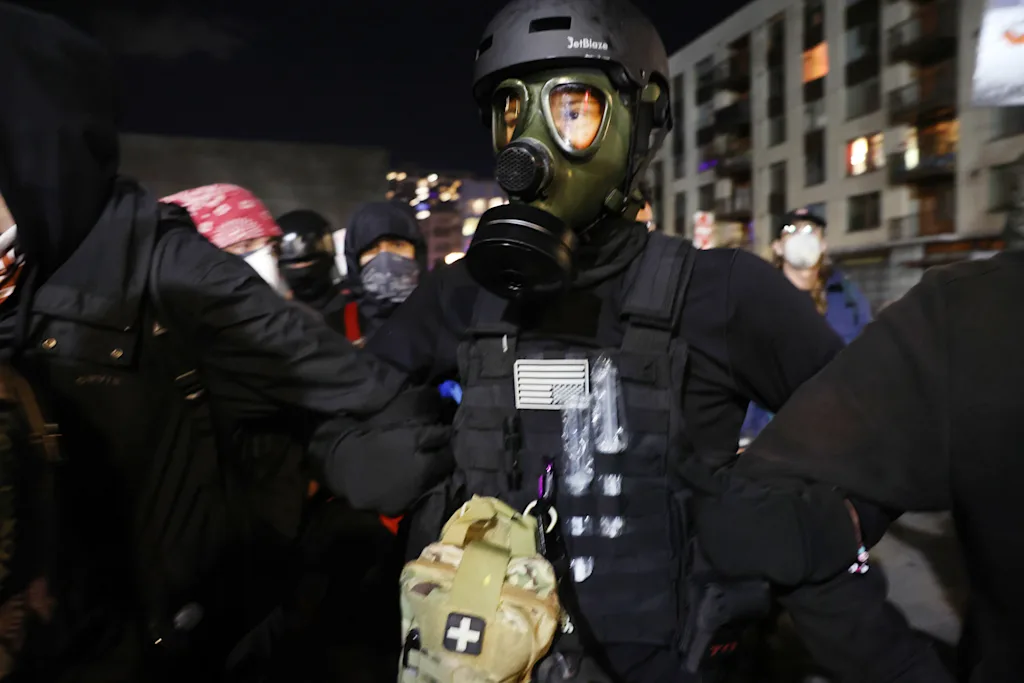
McFarlane links the growing consumer market for this gear to gun culture. “Men who are in their thirties, who grew up watching the global war and terror on TV and also probably played a lot of video games like Battlefield or Call of Duty, and it’s like, ‘Oh, I can own a version of that gun in real life.’ I got the gun. I kind of want the gear now too, and I think it builds out from there. It’s like collecting action figures.”

Incidentally, 5.11 Tactical, which makes plate carriers and weighted fitness vests, partnered with EA Games on Battlefield 6 to design more realistic combat uniforms and “bring an unparalleled level of authenticity to players,” said Kyle Peterson, senior director of brand for Battlefield in a news release; co-branded merchandise is also part of the deal.
An ununiform uniform
Tactical vests are evasive objects. Because immigration enforcement agents often wear civilian clothing, the tactical vest becomes a stand-in for a governmental authority. Remove the vest and you’ve got a pretty ordinary looking guy, which presents a problem since militias and vigilante groups have adopted the same attire. There’s not much visual difference between a January 6th rioter, far right protesters, ICE agents, or a Call of Duty fanatic. Sometimes, the visual uncertainty has had dangerous consequences. The FBI recently issued a warning about people impersonating ICE in order to commit violent crimes.
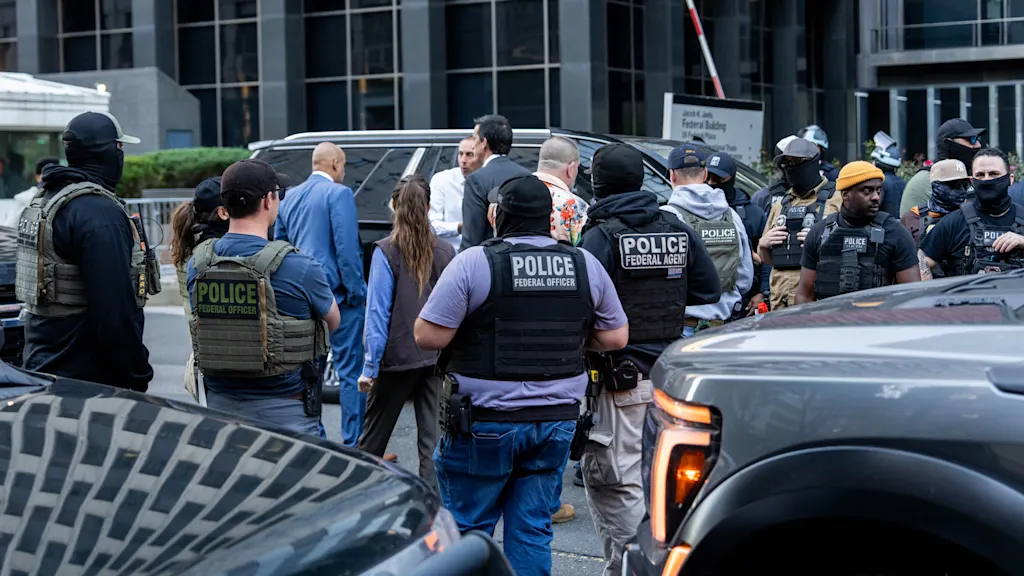
Naureen Shah, the director of government affairs, equality division at the American Civil Liberties Union, says that the menacing attire that makes it difficult to identify agents erodes public trust and opens the door to civil rights abuses. “The Trump Administration wants us not to know who [the agent] is because it wants to intimidate the public,” Shah says. “We don’t know if it’s ICE or the FBI or the ATF or the DEA or the National Guard. You really don’t know who’s behind that vest. I think that’s calculated chaos designed to instill fear, not just in immigrant communities, but in all of us.”
ICE has a long history of impersonating local police officers, a practice known as “ruses,” in order to gain access to spaces and information without furnishing a warrant. This includes wearing tactical gear that says “Police” and covering up badges that say ICE.
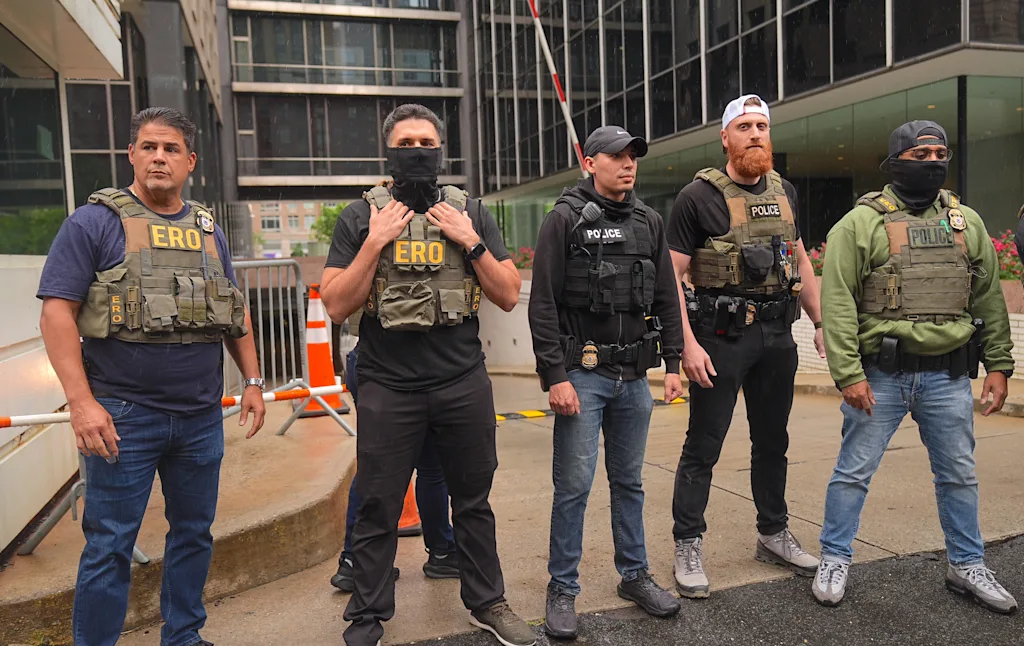
Meanwhile, attorneys general in New York and Minnesota recently wrote a letter to congress urging them to pass a law that requires ICE agents to wear agency-identifying insignia and prohibits identity-concealing masks. In 2020, the ACLU filed a lawsuit in Southern California to stop this deceptive practice; in August a settlement was reached that requires ICE field officers in Los Angeles to have visible ICE identifiers whenever they use the phrase “Police” on their uniforms.
“If you’re going to be policing the public, then you wear a uniform for that sense of accountability to the public,” Shah says.
The morale of the story
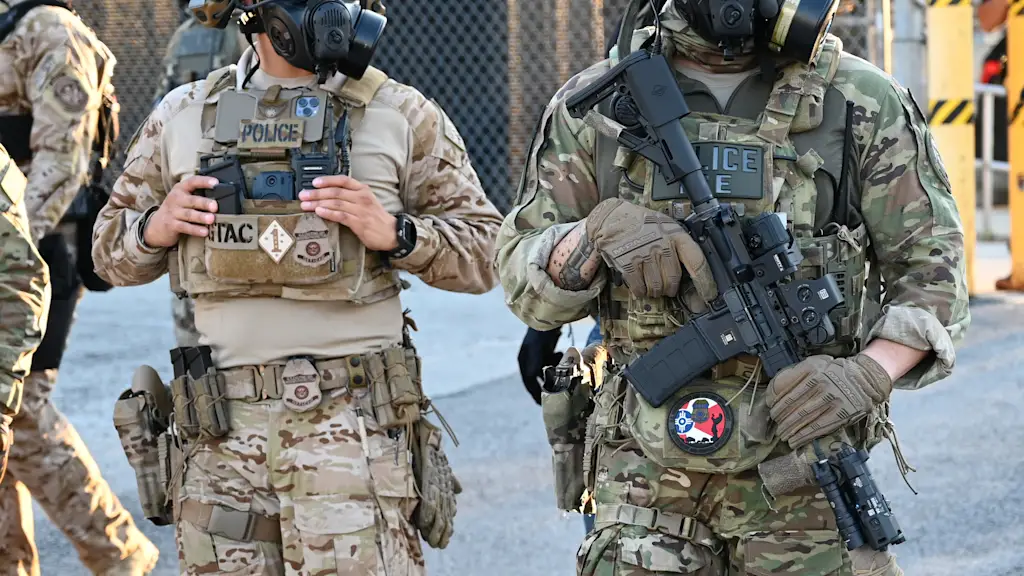
The use of military gear, like the tactical vest, in law enforcement represents its own type of psychology—one that projects power instead of the safety and competence that a police officer’s uniform was designed to do. This distinction is apparent in the ways ICE agents decorate their vests.
The same Velcro that brings functionality tactical vests also makes it easier to add flair, or what would be considered a “morale patch.” As McFarlane explains, the military has been using morale patches since WWI, but they had to be stitched on before the velcro, courtesy of the MOLLE system on tactical vests, became common.
Patches with a Superman logo, the Punisher, and a slogan from Deadpool have been spotted on tactical vests. The Punisher logo, in particular, has become a co-opted symbol by far right groups. The superhero theme is telling. “The way it’s presented in these stories is that they operate outside of the law, but to a higher purpose,” McFarlane says.
The Southern Poverty Law Center has been tracking the Department of Homeland Swcurity’s (DHS’s) use of hate symbols, which has included white nationalist and anti-immigrant imagery and language within recruitment ads. ICE is currently on a hiring spree—it plans to hire 10,000 agents by 2026—and it makes sense that the cohort who responded to those messages would wear those symbols as literal badges of honor.
“Since the beginning of the second Trump administration, several top DHS leaders and immigration advisers were drawn directly from hate groups making up the organized anti-immigrant movement. Agents sporting patches with hard-right emblems follow this disturbing trend,” says Travis McAdam, the manager of research and analysis in the Intelligence Project at SPLC.
McAdam notes that the organization has seen an increase in ICE and other federal agents attaching patches to their tactical gear with iconography favored by hard-right movements.
“One example is the Punisher symbol that’s long been a favorite of Three Percent militias, which feature it widely in their logos and merchandise,” he says. “While it’s used outside this antigovernment context, agents adopting it is consistent with the Department of Homeland Security’s use of hard-right imagery and language to both recruit employees and celebrate the arrest of Black and Brown people.” (Incidentally, DHS made Dean Cain, an actor who played Superman an honorary ICE officer this year.)
McFarlane is not impressed with the comic book nods. “I think it shows a lack of discipline,” he says. “That’s the kind of stuff that doesn’t really fly in the U.S. military. You’re not going to see someone with a Superman patch—or at least they’re going to have the sense to take it off when there’s a camera or superior around.”
These tactical vests, as well as the words, phrases, and iconography that appear on them, reveal a shocking dissonance between the people wearing them and the situations they are in: sledgehammering through the car windowing of an asylum seeker, arresting a pregnant citizen, and slamming a senior to the ground. Who really needs protection in these situations?
One Columbia psychologist has developed a theory called “enclothed cognition,” which argues that what we wear affects the way we think and behave. Military-coded garments evoke a combat-ready sensibility and the fact that menacing vests are ubiquitous is frightening.
“We’re not supposed to have federal officials who are designed to terrify people,” Shah says. “That’s not supposed to happen in a functioning democracy.”