
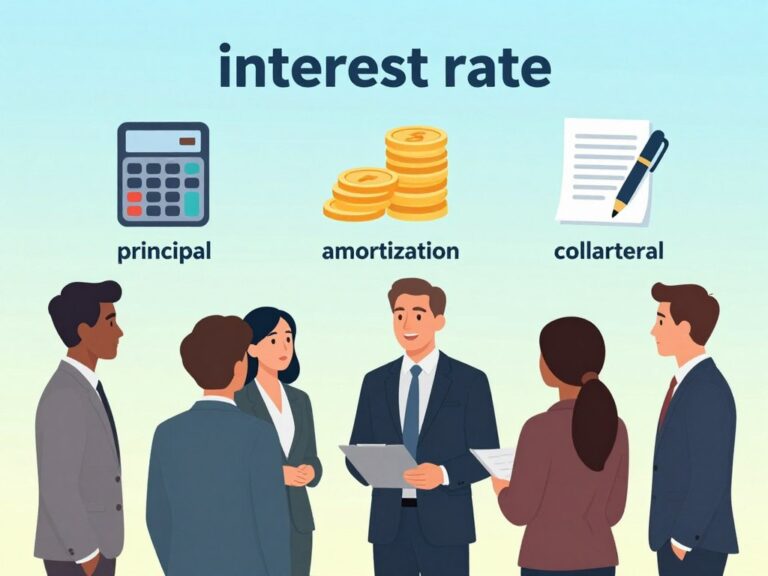
The basics of borrowing can feel dense, but a clear introduction helps a person get started. This section gives concise definitions and practical notes that a borrower will see in contracts and disclosures.
The Office of Loan Programs staff at the University of California frames many definitions around signed agreements and policy manuals. The UC Home Loan Program also uses funds from the Short-Term Investment Pool to support eligible faculty.
Understanding terms like interest, rate, principal, repayment period, and payment schedule helps people manage monthly costs. It also clarifies what a lender expects when a contract is signed and what rights the borrower has if status or documentation changes.
Readers will learn how costs are shown as an annual percentage rate and why that differs from simple interest. This guide aims to reduce confusion and highlight common traps in mortgage and credit transactions.
Understanding Loan Terminology Explained
Understanding core vocabulary reduces surprises during the application and closing process. It helps a borrower spot key differences in cost, rights, and obligations before signing any contract.
The University of California established a home program in 1984 to assist faculty and senior managers. That Mortgage Origination Program offered variable interest rate products and set a model for program disclosures in higher education.
A lender often checks credit and income on a standard form to set an approved amount and status. The amortization schedule shows how principal and interest change with each payment over the repayment period.
| Term | Meaning | Where it appears | Why it matters |
|---|---|---|---|
| Promissory Note | Borrower’s promise to repay | Closing documents | Creates a legal obligation |
| Deed of Trust | Secures the loan with property | Title records | Affects property rights |
| Right of Rescission | Short cancellation window | Refinance disclosures | Protects the borrower |
| Interest Rate | Cost expressed as percentage | Promissory note & disclosure | Determines monthly payment |
Core Components of a Loan Agreement
A clear view of a contract’s parts helps a borrower spot risks and costs early. This section lays out two central items found in most agreements and why they matter for repayment and overall cost.
Promissory Notes
A promissory note is a legal, binding contract signed between the lender and the borrower. It records the amount, rate, payment schedule, and the date payments begin.
The note also gives the lender the right to collect the full amount if the borrower fails to repay. In property transactions, the person signing the note is also known as the mortgagor.
Principal Balance
The principal balance is the debt amount remaining at any time, not including interest. Regular payments reduce that balance; early extra payments lower interest costs because interest accrues on the unpaid principal.
Formal agreements include disclosures of fees and charges due at closing. If a borrower defaults, the lender may pursue remedies to recover outstanding principal and interest.
| Component | What it records | Who holds rights | Why it matters |
|---|---|---|---|
| Promissory Note | Amount, rate, payment dates | Lender enforces repayment | Creates legal repayment duty |
| Principal Balance | Remaining debt excluding interest | Borrower owes this amount | Determines future interest and payments |
| Disclosure | Fees and closing costs | Both parties review | Clarifies total funds required |
Interest Rates and Annual Percentage Rates
Interest charges and fee disclosures shape the real cost of borrowing and deserve careful review.
The annual percentage rate reflects the total cost of borrowing money. It includes the interest rate, broker fees, points, and other charges that raise the overall amount a borrower repays.
- The annual percentage rate is broader than the simple percentage rate quoted in a promissory note.
- Because APR includes fees, it is usually higher than the stated interest rate.
- Federal law requires lenders to disclose the annual percentage rate so borrowers can compare offers.
- Even small changes in the rate can change the monthly payment and total interest over the repayment period.
| What | What it shows | Why it matters |
|---|---|---|
| Interest rate | Annual cost percentage charged by the lender | Determines monthly payment |
| Annual percentage rate | Rate plus fees and points | Shows true cost to compare lenders |
| Fixed-rate note | Rate stays the same for the period | Predictable payments and budget planning |
Navigating the Loan Application Process
Starting an application can feel like navigating paperwork, but a clear roadmap helps applicants move forward with confidence.
Pre-approval
Pre-approval is a formal check where the lender verifies credit, assets, and income to set the approved amount. The Application Checklist, also known as form OLP-09, must be submitted to the Office of Loan Programs to begin this step.
Underwriting
Underwriting analyzes risk based on employment, assets, and credit history. The underwriter reviews inspections, property documentation, and debt-to-income ratios to confirm ability to make payments.
Loan Commitment
After satisfactory review, the Office of Loan Programs issues a commitment letter that locks the initial interest rate if the file closes within 60 days of the date issued. The commitment prepares final closing documents and authorizes funds at escrow.
- Evidence of insurance is required to protect the property during the period before closing.
- Borrowers should watch the commitment expiration date to avoid rate or terms changes.
| Stage | What is checked | Key document | Why it matters |
|---|---|---|---|
| Pre-approval | Credit, income, assets | OLP-09 Application Checklist | Sets qualifying amount and timelines |
| Underwriting | Employment, inspections, DTI | Underwriter report | Assesses risk for final approval |
| Commitment | All docs and property review | Commitment letter (60-day term) | Locks rate and authorizes closing funds |
| Closing | Final signatures, funds transfer | Closing statement and note | Completes repayment obligation and disburses funds |
Property Valuation and Appraisal Concepts
An independent appraisal anchors the property value used in underwriting and risk checks.
An appraised value is the dollar amount assigned to a single-family residence by an appraiser approved by the Office of Loan Programs.
The appraisal gives the lender an objective measure of value. That figure helps calculate the loan-to-value percentage and shows whether the property will secure the amount requested.
- If the purchase price exceeds the appraised value, the borrower may need a larger down payment to close.
- A home inspection often runs alongside the appraisal to flag structural or mechanical issues that could lower value.
- The borrower is typically responsible for ordering and paying for the appraisal and inspection reports.
| Item | What it shows | Why it matters |
|---|---|---|
| Appraised value | Independent dollar estimate | Sets maximum collateral for the loan |
| Loan-to-value | Balance divided by appraised value | Determines lender risk and rate options |
| Inspection | Condition and defects | Can affect final payment and insurance needs |
Understanding Repayment and Amortization
Understanding amortization helps a borrower see how monthly money moves from interest to principal over time.
Amortization is the process of paying off a debt by equal periodic amounts. Each payment covers both principal and interest so the principal balance falls with time.
Balloon Payments
A balloon payment is a final installment that is much larger than prior payments. It appears on some promissory note forms when the schedule does not fully amortize.
Borrowers should check the note and the program terms to see if a balloon is required or if early repayment options exist.
- Amortization lets the borrower reduce the principal balance through regular monthly payments that include interest.
- If a loan does not fully amortize, a large balloon payment will be due at maturity to clear the remaining amount.
- The principal interest to income ratio is used to confirm the borrower can afford ongoing payments.
- Making extra payments toward principal cuts the total interest paid over the life of the loan.
- Some programs offer a graduated payment schedule that starts lower and rises over time, affecting rate and payment planning.
- The lender issues an IRS 1098 statement each year showing total interest paid for credit and tax records.
| Feature | Amortizing plan | Non-amortizing / balloon |
|---|---|---|
| Regular payments | Equal amounts covering principal & interest | Smaller periodic payments, large final payment |
| Final amount due | No large remaining balance | Significant balloon needed at maturity |
| Lender action | Provides amortization schedule and rate details | Discloses balloon terms in the note and program documents |
Managing Debt and Financial Ratios
Strong debt management helps a borrower show steady cash flow and qualify for better terms.
The overall debt-to-income percentage is the sum of monthly debt payments divided by gross monthly income. For MOP programs, the Office of Loan Programs caps that ratio at 48%.
The principal interest to income ratio measures mortgage affordability. That percentage must be 40% or less for MOP loans. Lenders use it to confirm the payment amount is sustainable.
- Lenders verify gross monthly income before taxes to ensure ratios meet program limits.
- High recurring obligations—student or auto payments—reduce qualifying capacity.
- If ratios are too high, the lender may require a larger down payment or deny the application.
- Good credit and lower debt often produce a better interest rate and lower monthly payments.
| Ratio | How it’s calculated | MOP limit / purpose |
|---|---|---|
| Overall debt-to-income | Total monthly debt payments ÷ gross monthly income | 48% — shows total monthly obligations |
| Principal & interest to income | Monthly principal + interest payment ÷ gross monthly income | 40% — measures mortgage payment affordability |
| Lender verification | Income, assets, and recurring debts checked | Ensures borrower has funds for payments and insurance after closing |
Insurance and Protection Requirements
Insurance and title protection guard both the borrower and the lender from costly surprises. These requirements secure the property that backs the loan and help keep payments predictable.
Hazard Insurance
Hazard insurance compensates the insured for loss to the property from events such as fire, wind, or theft. The lender requires proof of coverage before closing so the collateral remains protected.
Homeowner policies often exclude flood and earthquake damage. In those cases, the borrower must buy separate coverage. If the borrower lets required coverage lapse, the lender may buy force-placed insurance and bill the borrower for the cost.
Title Insurance
Title insurance protects both the homebuyer and the lender against errors found in the title search. It defends against legal claims or hidden liens that could threaten ownership.
- Owner’s policy cost is usually a percentage of the sales price.
- Lender’s policy cost typically ties to the loan amount as a percentage.
- Maintaining continuous coverage is a condition of the agreement; failure can lead to default on the note.
| Protection | Who it protects | Typical cost basis |
|---|---|---|
| Hazard insurance | Borrower (and lender interest) | Annual premium paid to insurer |
| Title insurance | Owner and lender | Percentage of sales price or loan amount |
| Force-placed insurance | Lender protects collateral | Charged to borrower if coverage lapses |
Default and Foreclosure Procedures
When payments stop, the steps from missed installments to property recovery are formal and regulated.
Default occurs when the borrower fails to meet duties in the promissory note or the deed of trust. On most accounts, a lender may class the file as in default after about 180 days of missed payments.
- Before foreclosure starts, the lender must give formal notice and a chance to cure the debt.
- The borrower can pursue loss mitigation, such as forbearance, to pause or reduce scheduled payments.
- If the default is not resolved, the lender may begin judicial or non-judicial foreclosure to recover the property.
- A deed-in-lieu of foreclosure lets the borrower transfer ownership to avoid formal proceedings.
| Stage | Typical action | Short-term impact |
|---|---|---|
| Notice | Demand cure or payment plan | Opportunity to avoid foreclosure |
| Foreclosure | Property sale or repossession | Severe credit damage and debt collection |
| Deed-in-lieu | Voluntary transfer to lender | Avoids sale but reduces borrower equity |
Collectors must follow the same strong practices used by financial institutions for consumer credit. Foreclosure can sharply lower a borrower’s credit score and increase the total amount owed due to fees and accrued interest.
Advanced Loan Programs and Specialized Terms
Variable-rate products give short-term savings, yet they require careful planning for future changes.
An adjustable rate mortgage shifts the interest rate periodically with an index. This can change the monthly payment amount after any fixed period ends.
The Mortgage Origination Program (MOP) uses the University’s Short-Term Investment Pool to offer competitive terms. Eligible faculty may access variable interest financing up to 30 years.
Key features to review
- 5/1 ARMs have five years fixed, then annual adjustments for the remaining term.
- MOP limits annual rate changes to one percent, up or down, which caps sudden spikes.
- Some programs allow interest-only or negative amortization; those raise long-term risk and complex payment math.
- Before applying for a new loan, the borrower should use the MOP-Calculator and ask the lender about rate caps and payment scenarios.
| Feature | What it means | Risk | Why it matters |
|---|---|---|---|
| 5/1 ARM | Five years fixed, then annual resets | Payments can rise after fixed period | Good for short-term plans or refinancing |
| Annual adjustment cap | Max change per year (MOP = 1%) | Limits payment volatility | Provides borrower protection |
| Interest-only option | Pays interest for a period, principal unchanged | Can raise balance and future payments | Lower initial payments but higher long-term cost |
Conclusion
A concise recap can turn complex paperwork into manageable next steps. Mastering key financial terms is the first move toward a smoother homebuying experience.
Readers should focus on total cost, including interest rates and all disclosed fees. They should also keep credit strong and monitor debt-to-income ratios to qualify for better terms.
Always read the promissory note and legal documents before signing. Stay current on appraisal results, insurance needs, and repayment plans to protect the investment.
If planning to apply for a new loan, use lender resources and ask clear questions. Being informed reduces surprises and helps secure the best outcome.